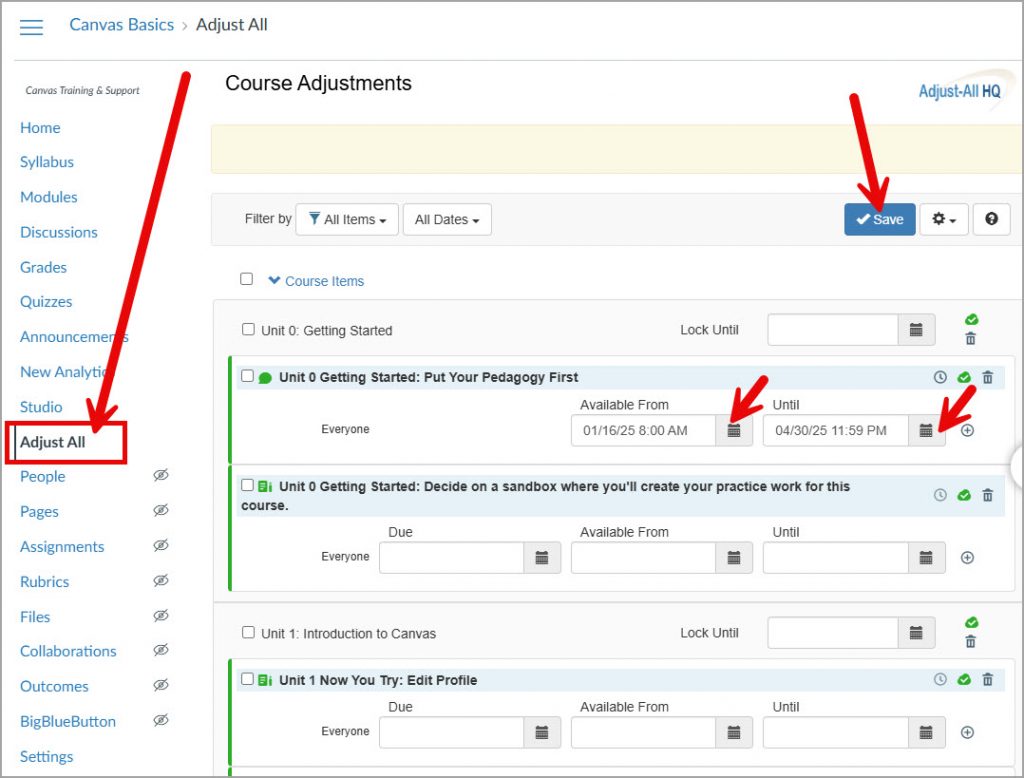
Adjust-All is a simple Canvas tool that enables you to change all course item due dates and announcement publication dates in one place, rather than having to access each item individually.
The first time you use Adjust-All, you’ll need to click the blue Authorize button – it’s fine 😊
This tool is only available to faculty – students won’t see it in your course menu.
There are a few other things you can do with Adjust-All. Click the gear icon at top right to see options for bulk adjustments to dates or publishing status.
ADAPT is a free and open online homework system from LibreTexts. Think of it as your all-in-one hub for creating engaging assessments. ADAPT solves a common open educational resource (OER) challenge by bringing different homework technologies (like H5P, WeBWorK, and iMathAS) under one roof. This gives you the freedom to mix and match from a vast library of existing questions to create engaging assignments for your students, without getting bogged down by technology.
Key Features
Large, customizable question library
Question types (can include interactives, simulations, 3D models, code):
Canvas-like questions: multiple-choice, true/false, fill-in-the-blank, essays, matching, drop downs, categorization, ordering, hot spots
Highlight table or text
Drag and drop
Sketcher (molecular structure building)
Discuss-it (discussion board with audio, video, and/or text inputs)
Learning trees (students start with a “root” problem and are offered branching pathways based on how they do)
View data on students engagement and performance to adjust teaching
Explore this sample ADAPT assignment to see some of the questions that can be built. You can view this video from LibreTexts (8:58 – 14:50) alongside the sample assignment to get detailed explanations of each question type.
How to Get Started with ADAPT
Step 1: Get Instructor Account
Register for a LibreOne Account (this gives you access to all of LibreTexts’ applications).
Step 2: Create Your First Course
Once you log in and click into ADAPT, your dashboard will be empty. Here is how you can create a course:
Click “New Course”.
Fill in Course Details.
Check “Yes” for LMS.
Click “Save”.
Step 3: Build an Assignment
Click into the course that was just created.
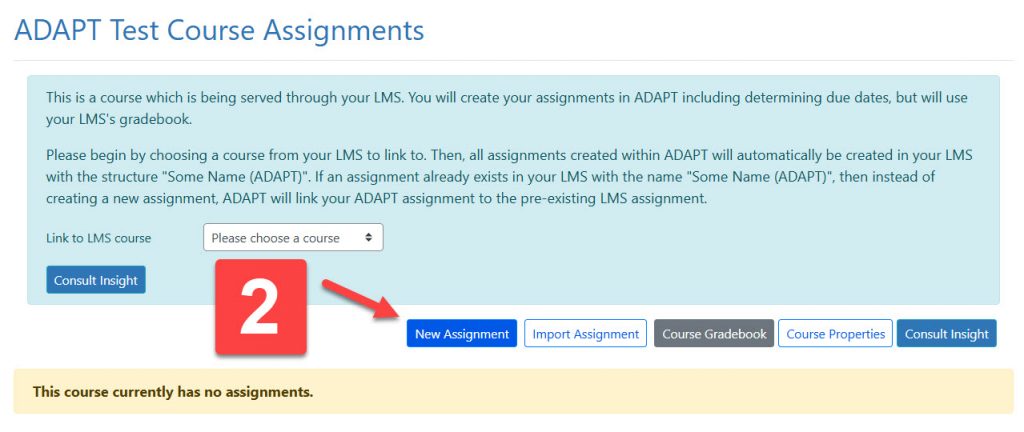
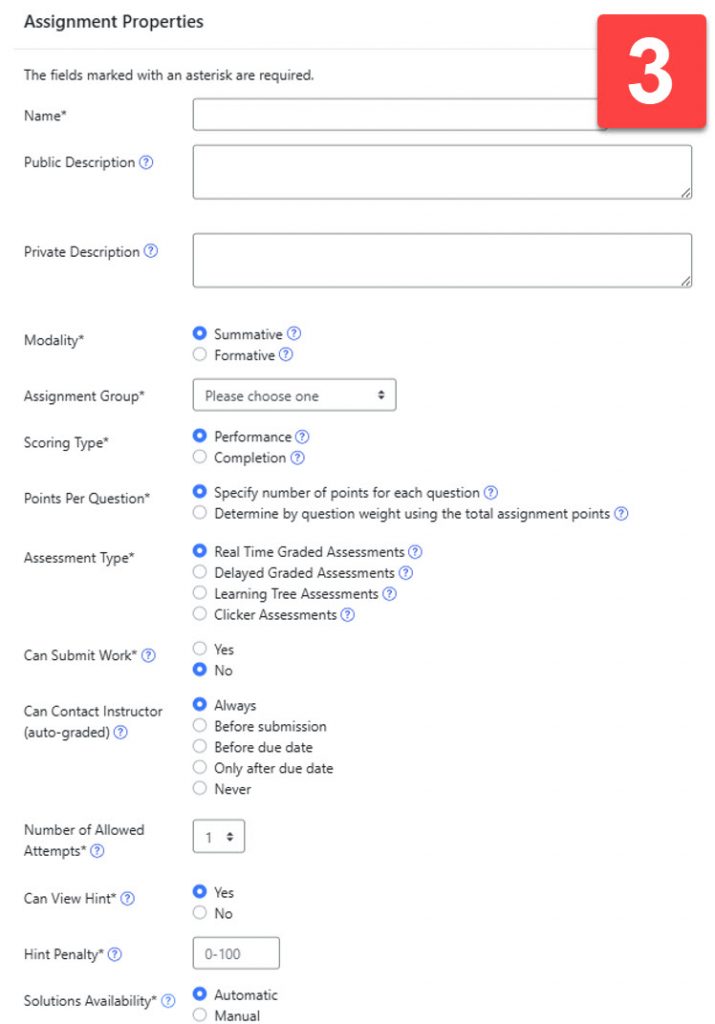
Click “New Assignment”.
Set assignment properties.
Click “Save”.
Add Questions from Existing ADAPT Library
Click on the assignment that you’d like to add questions to.
Click “Add Questions”.
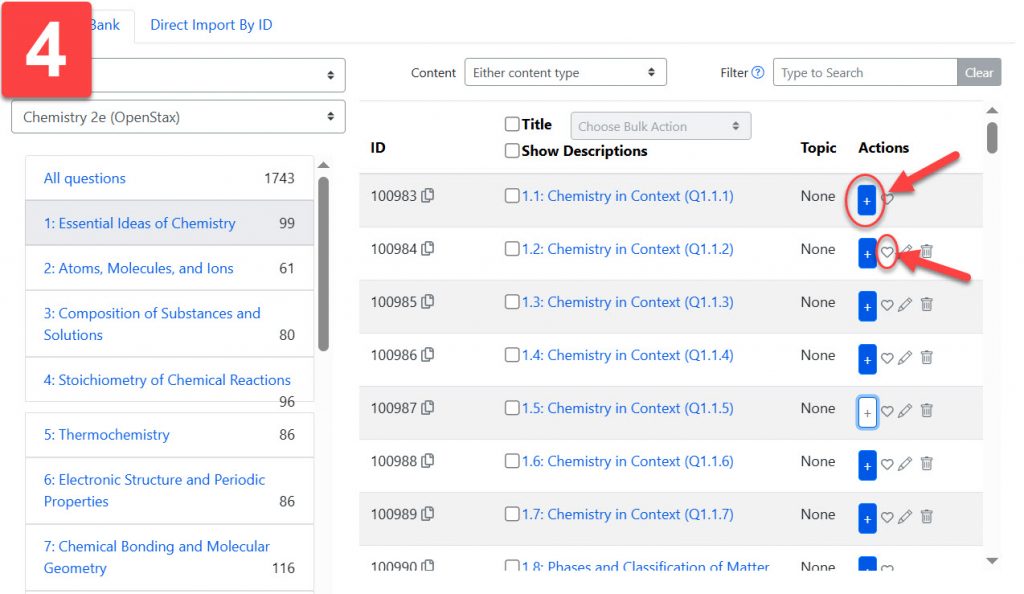
Choose a question source
“Search Questions” lets you filter questions by several different properties.
“My Questions” takes you to a library of questions that you have adapted or created.
“My Favorites” shows you questions that you have favorited.
“My Courses” allows you to select questions from other courses that you have created.
“Commons” contains questions for courses that have been curated by the ADAPT/LibreTexts team. They could be courses matching a specific textbook or ones geared towards a course/topic.
“All Public Courses” shows you questions created and made publicly available by other ADAPT users.
Browse questions available to you. Clicking on a question will allow you to preview it in a pop-up window. Click the “+” icon to add them to your assignment. Clicking the heart icon will allow you to add questions to a Favorites folder to be used at a later time.
Create Own Questions
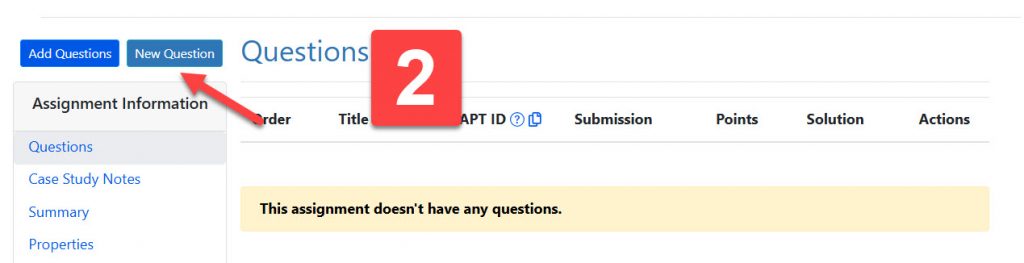
Click on the assignment that you’d like to add questions to.
Click “New Question”.
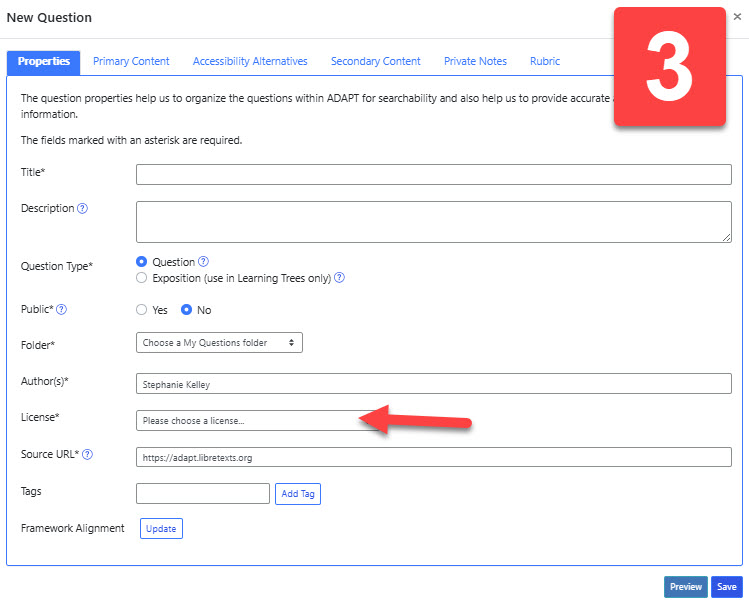
Fill in “Question Properties”
When selecting a License, an open one is preferable so others can benefit from your work!
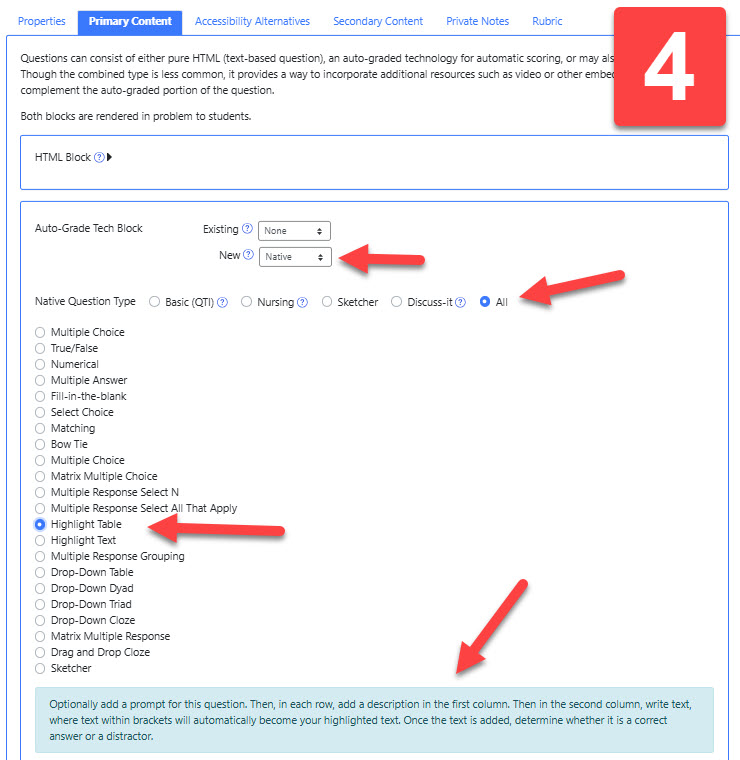
Fill in “Primary Content”
Use “HTML Block” if the question you are creating is purely text-based.
If you would like to import H5P, WeBWorK, or iMathAS content that you have, go to the “Auto-Grade Tech Block” and “Existing” to make a selection.
To build a question using ADAPT’s templates, go to “Auto-Grade Tech Block” and next to “New” select “Native”.
Next to “Native Question Type” select “All” to see all the types of questions you can build. When you select a question type, the blue box below will explain what kind of interaction students will experience and how to format your question.
Click “Save”.
Step 4: Share with Students in Your MCC Canvas Course
In Canvas, create a new assignment that you would like to use ADAPT for.
Next to “Submission Type,” select “External Tool” and then select “ADAPT”.
Once to click “Save”, you will be directed to select the ADAPT course and assignment that you would like to link to the Canvas assignment. Click “Link Assignment” once you’ve made your selections.
Alternatively, you can go to your ADAPT course and link it to a Canvas course. Doing this will automatically populate the Canvas course with all the assignments you’ve created in the linked ADAPT course.
Step 5: Grade an Assignment
By default, ADAPT courses are set for students to access and use them from within the LibreTexts website rather than from within Canvas. So, the course properties must be set to enable the ADAPT course to interact with Canvas Grades.
Make sure your ADAPT course is set to interact with your Canvas gradebook.
Click on the course properties icon next to the course.
Check the box for “Yes” next to “LMS”. Click “Save”.
Click the checkmark icon next to the assignment you would like to grade and this will take you to ADAPT’s grader.
The grader will allow you to view and grade both open-ended and automatically graded submissions.
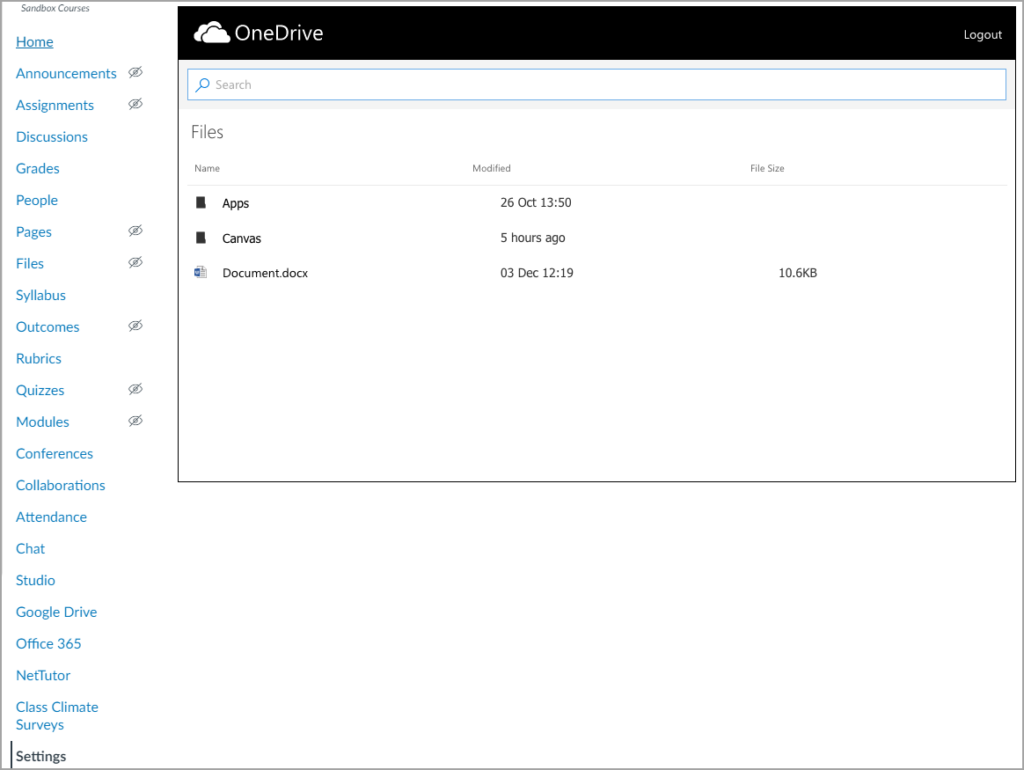
MiraCosta College Canvas supports an LTI integration with Microsoft Office 365 in Assignments, Collaborations, Modules, Course Navigation, and the Rich Content Editor. This integration allows students and instructors to use, create, share, and collaborate on Office 365 files within Canvas. Users can also view their OneDrive files directly in Canvas.
Enable the Office 365 Integration in Canvas
Enter your Canvas course
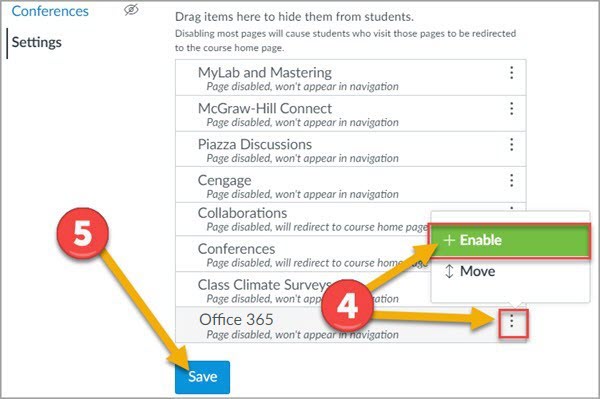
Click Settings on the course menu
Click the Navigation tab
Click the 3 dots to the right ofOffice 365 and select Enable.
Click the Save button
Log on to Office 365 as a Faculty / Staff Member
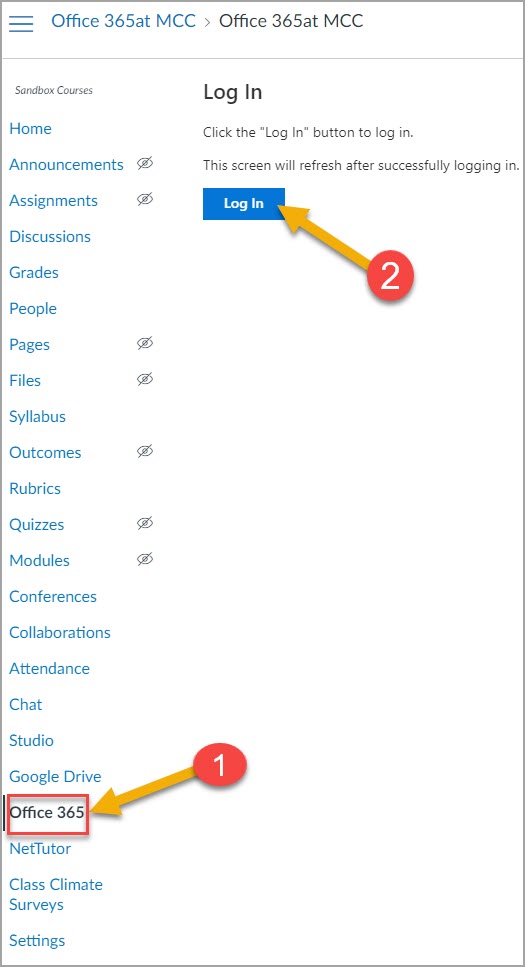
Click the Office 365 course menu item which will appear in your course menu.
Click the Log In button.
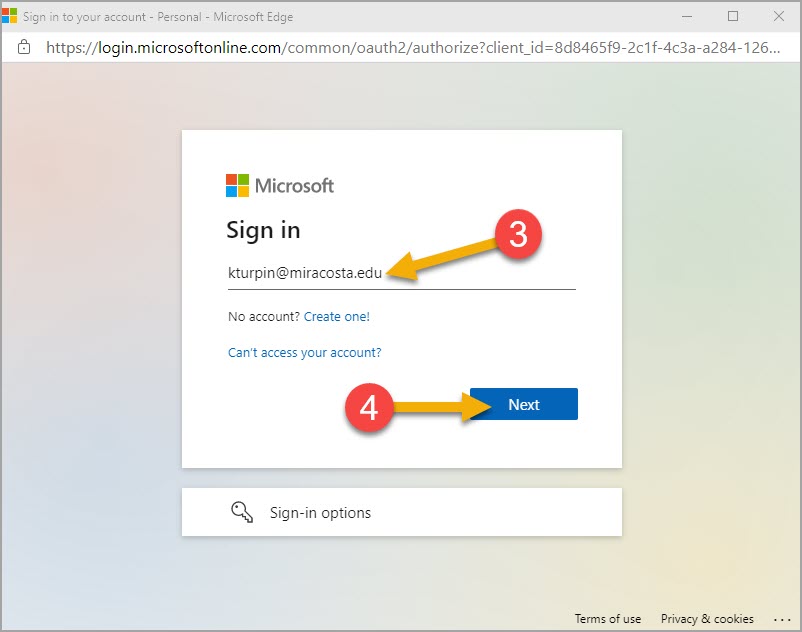
Enter your Faculty / Staff MCC email address
Example: kturpin@miracosta.edu
Click the Next button
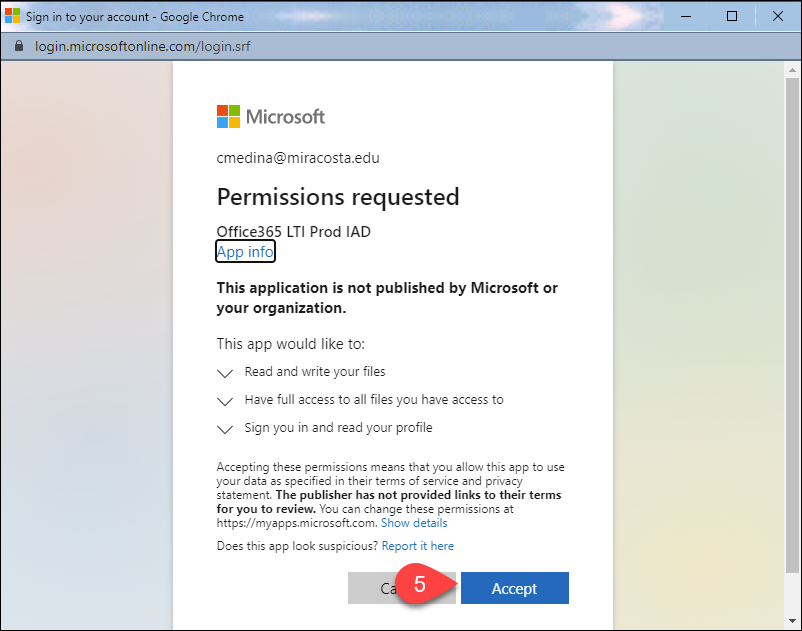
Click the Accept button on the Permissions requested page. Note: This page will only display the first time you log on to the Office 365 Integration in Canvas.
Now you can access Office 365 documents from inside of Canvas.
Students log on to Office 365 with their MiraCosta Student Email Address They may also use their SURF ID + “@student.miracosta.edu“ Example: W71234567@student.miracosta.edu
Faculty Support & Student Support for Office 365 is provided by the ITS Help Desk.
Canvas Studio (Recording, 57 minutes) – 1/17/2023 workshop by Nadia Khan and Karen Turpin – Additional Resource:Presentation Slides
Studio is a video tool integrated inside of Canvas, available to all faculty and students.
With Studio:
Faculty and students can easily record webcam and screencast video within Canvas
Faculty and students can create and manage a library of videos for use in Canvas (and to share outside of Canvas)
Faculty can create discussion activities that are based on video (discussion comments are tied to specific points in the video)
Faculty get data on student viewing of video
Faculty can add quiz questions into videos; students respond while watching the video; results go directly into the gradebook
Students can submit video assignments; faculty can provide feedback directly on specific moments in the video
Videos can be automatically captioned and the captions can be easily edited
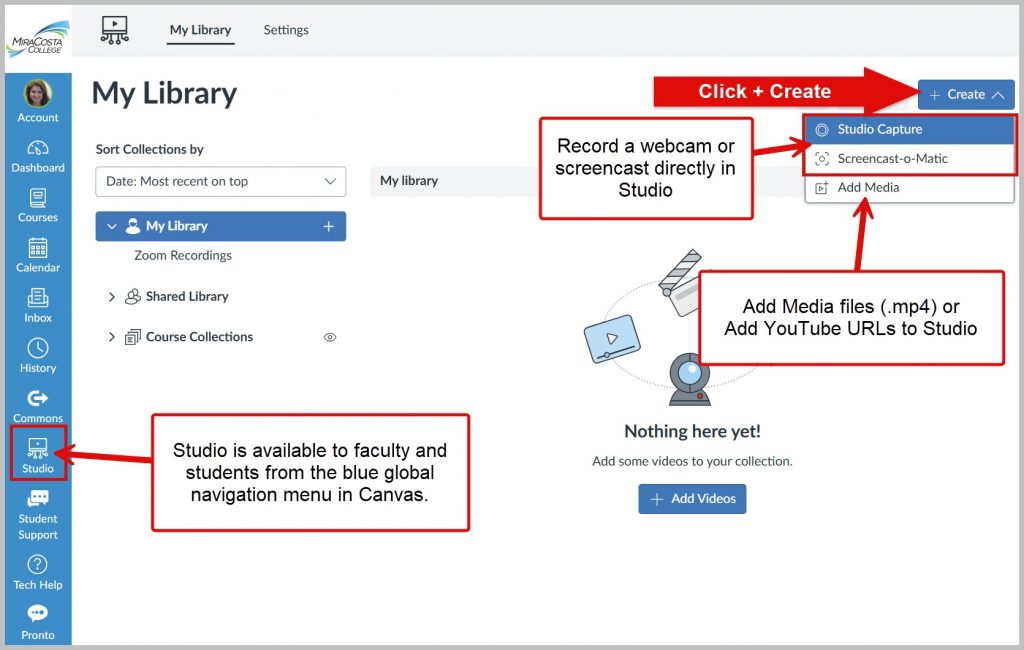
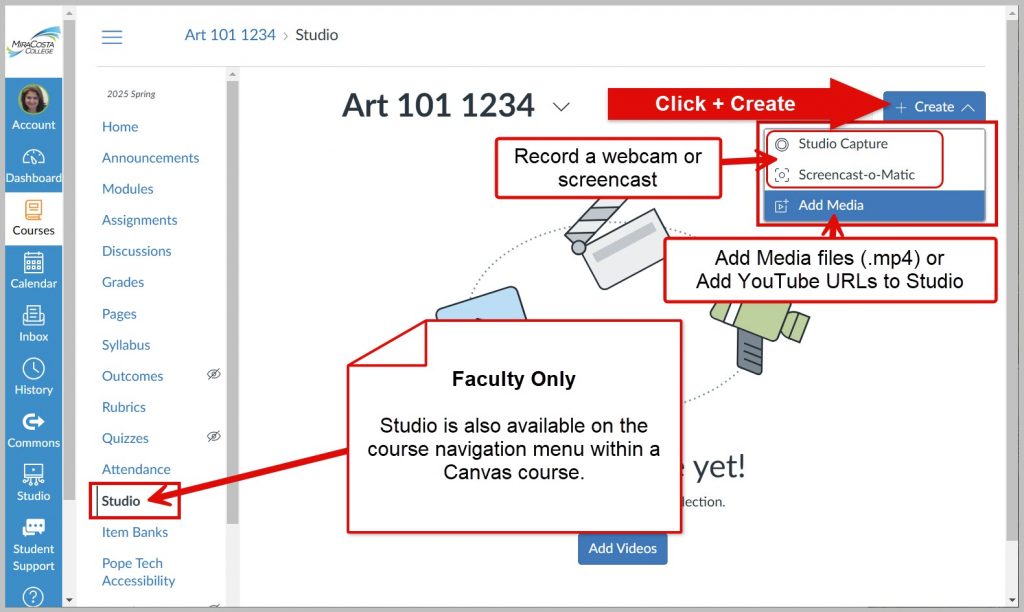
Studio is available to faculty and students from the blue global navigation bar in MiraCosta Canvas.
Studio is also available to faculty only on the navigation menu within a MiraCosta Canvas course to RECORD or ADD video content.
Within the Canvas Rich Content Editor, faculty and students can select Studio from the second row of icons to add a Studio video they’ve previously recorded, or to create and use a webcam or screencast video right there.
Canvas Studio supports an integration with Zoom that allows Zoom to automatically upload recorded meetings into Studio. Here is how you can authorize the Studio Zoom integration in your Canvas Studio Settings.
Zoom provides a reliable, easy-to-use, mobile-friendly tool for live, recordable online presentations, meetings, and discussions with audio, video, chat, screen sharing, polling, and more. It can be used within Canvas or independently.
Zoom Pro is available to all MiraCosta faculty and staff at no charge. Students don’t use the Zoom Pro account but can use free Zoom basic accounts. Nobody at MiraCosta should be paying anything to use Zoom!
The version of Zoom that MiraCostans use changed after the fall 2020 semester; MiraCosta Zoom is now accessed at miracosta-edu.zoom.us rather than conferzoom.org or cccconfer.zoom.us. Faculty need to sign in to Zoom with their MiraCosta College login and password to obtain unlimited pro (“licensed”) access to all features of Zoom, including:
Unlimited meeting lengths and very large numbers of attendees
Recordings “in the cloud” so that you do not need to manage large files of your recorded meetings
Auto-transcription of your cloud-based Zoom recordings
This page includes basic technical how-to information and resources on using Zoom in general, and Zoom use in tandem with Canvas. Please see our separate Teaching with Zoom at MiraCosta College page for more detailed tips about teaching securely, effectively, and accessibly with Zoom.
Log On to Zoom at MiraCosta College
To access your Zoom account via the web go to: https://miracosta-edu.zoom.us Sign in with your MiraCosta College employee account and two-factor authentication (2FA).
How do I get a Zoom account? If you had a pro Zoom account through ConferZoom prior to 2021, it should have been automatically migrated to the MiraCosta Zoom, and there’s nothing you need to do. If you did not previously have a Pro Zoom account, and need to create a MiraCosta Zoom account, sign in to the MiraCosta Help Desk in the Portal and select the User Accounts option.
What if I’m having trouble with my Zoom account? Sign in to the MiraCosta Help Desk in the Portal and click the User Accounts button to request help.
What happened to my Zoom recordings made before 2021? They are still in your Zoom account! The old links to Zoom recordings will still work, but a message will briefly appear when people click an old link. If you update an old recording link with the new MiraCosta Zoom URL (replace cccconfer.zoom.us with miracosta-edu.zoom.us in the link) it will work seamlessly.
What happened to my recurring Zoom meetings I set up before 2021? Similar to your recordings, old links to recurring Zoom meetings will still work, but a message will appear when people click an old link. If you go to your Zoom account, you’ll see that your meetings have been migrated in, and you can get a new invitation. You can also simply update a meeting link created before 2021 with the new MiraCosta Zoom URL (replace cccconfer.zoom.us with miracosta-edu.zoom.us in the link).
What happened to Reports from Zoom meetings held before 2021? They are gone, sorry.
How much storage do I have for Zoom recordings? As of spring 2021, there is not a limit; however, this may change in the future if we do not manage our recordings well. Please delete recordings that you do not need.
Zoom Documentation
The following Zoom trainings, documentation, and resources can help you stay informed:
You can schedule and share Zoom meetings and recordings directly within Canvas, using the Zoom integration. To get started and learn more about the Zoom/Canvas integration, see directions below.
Note: You may also share individual Zoom meeting links and recordings in Canvas without using the integration.
Canvas Integration with Zoom
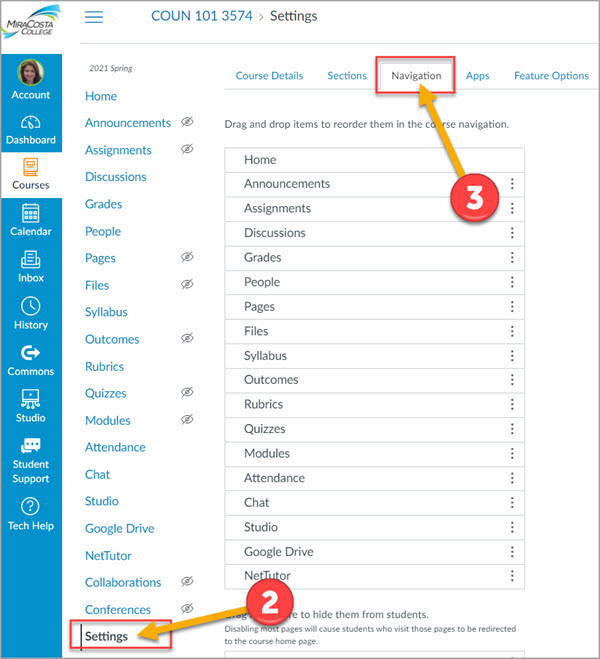
Enter your Canvas course
Click Settings on the course menu
Click the Navigation tab
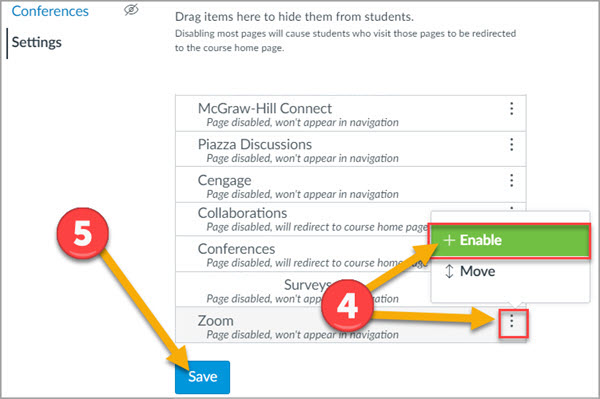
Click the 3 dots to the right of Zoom and select Enable.
Click the Save button
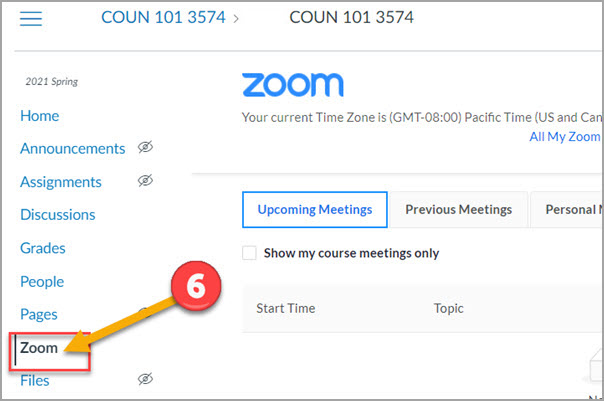
Click the Zoom course menu item which will appear in your course menu.
Now you can schedule and access Zoom meetings from inside of Canvas.
Viewing All My Zoom Meetings in Canvas
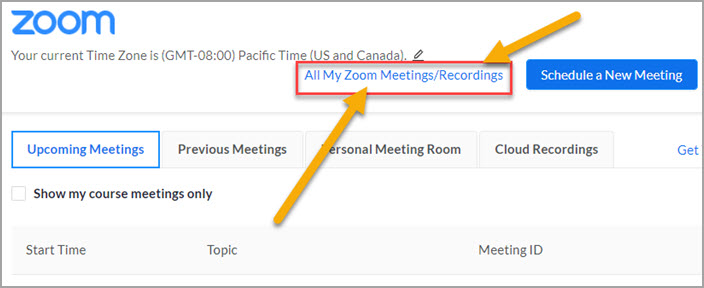
When you first enter Zoom on Canvas you will see only the Zoom meetings associated with the Canvas course you entered from. To see and access all Zoom meetings within your account, click the link ‘All My Zoom Meetings‘.