
Validate your course links in Canvas

It is important to verify that all links are working throughout a course. The course link validator tool can help make this task easy for faculty designing and teaching courses.

The course link validator tool searches through course content and returns invalid or unresponsive external links in both published and unpublished content.

The link validator also includes deleted links. Deleted links are links that are still in the course, but their linked content has been deleted (such as a course files or pages).

Note: Some links flagged as unresponsive are inaccessible by Canvas servers and will still work for students.

From within a Canvas Course

Open Settings

Canvas Settings

Select Validate Links in Content

Validate Links in Content

For additional directions refer to the Canvas guide: How do I validate links in a course?

Reset Your Canvas Course Content

Overview

From time to time, you may want to delete all of the content in a Canvas course site. This is most typically needed early in the course building process. For example, after importing content from another course, you may realize that you imported from the wrong course. The directions described below will delete all content from your course site, but leave the course roster intact.

Warning about Deleting All Course Content

WARNING: This step deletes all existing content from your course. Take steps to preserve any content you want to keep (for example, copy and paste to a Word doc, copy select course elements to a sandbox course, import the course into another empty shell, etc.) before proceeding. DO NOT complete these steps in a current term course that is currently in process!

Reset Course Content in a Canvas Course

Canvas Guide: How do I reset course content?

1. Navigate to the course with the content you wish to delete.

2. From the course navigation menu, click the Settings link.
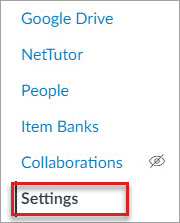
Settings

3. In the sidebar, click the Reset Course Content link.
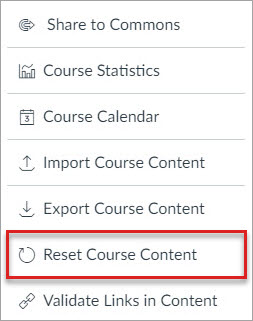
Reset Course Content

4. Click the Reset Course Content button.
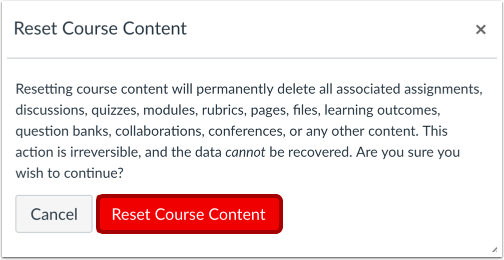
A completely new course shell with a new ID (the number following “https://miracosta.instructure.com/courses/…”) will be generated. All users previously enrolled in the course will remain enrolled.

Made a Mistake?

If for some reason you reset your course and it was a mistake report it as soon as possible. We have Test and Beta instances of Canvas we may be able to refer to for the content and/or to restore the original course.

Contact Karen Turpin, Instructional Technology Specialist at kturpin@miracosta.edu or Canvas Faculty Support 24/7 at 1- 833-345-2890 for assistance.

Try These 10 Things To Fix Your Computer Problem Before You Call Support

Troubleshooting computer problems is part of modern life when you teach online. Before you make that support call, try your hand at fixing some of the most common problems yourself.

  1. Check your Course Management System (CMS) Status
    Is it a maintenance time? Or is  Canvas currently experiencing an outage?
    1. Canvas Status Updates
    2. Stay Up To Date with Changes Happening within Canvas
  2. Clear Browser Cache (history, cookies, etc.)
    Clearing your browser cache often will resolve the problem by allowing your computer to download the latest version of the webpage and/or software.
  3. Try a Different Browser
    If you have cleared your browser cache and things are still not working as you expect try a different browser. Example: if you are using Chrome, try Firefox and visa versa. Ensure that your browsers are up to date. You can always download the latest version free online.
    1. Chrome
    2. Firefox
    3. Which browsers does Canvas support?
  4. Restart your Computer
    Many faculty and staff solve their problems with this simple step. Always a good option to try.
  5. Check your Internet Connection Speed
    A slow connection could be why your CMS system is running slow.  Share your result with your internet service provider as necessary to resolve.
  6. Enable Browser Cookies
    Cookies are small files which are stored on a user’s computer. They are designed to hold a modest amount of data specific to a particular client and website, and can be accessed either by the web server or the client computer. This allows the online server to deliver a page tailored to a particular user, or the page itself can contain some script which is aware of the data in the cookie and so is able to carry information from one visit to the website (or related site) to the next.
  7. Enable Java
    It strongly recommended to have the latest version to ensure proper functionality of our online systems.
    1. Review ‘What is Java and Why do I need it?
    2. Download Java
  8. Manage Pop-Up Blockers
    Pop-up windows, or pop-ups, are windows that appear automatically without your permission. They vary in size but usually don’t cover the whole screen. They are often required for certain online website applications to work properly.
  9. Make sure that your Operating System is fully updated. 
    Neglecting updates could deprive you of important bug and performance fixes.
    1. Apple Computer
    2. PC Computer 
  10. Check your Device Settings

Adding Faculty Evaluators, TLC Staff, Community Ed Students, Substitute Instructors, and TAs to Canvas classes

Students and Instructors are automatically enrolled from SURF to your Canvas course several times a day.

For the roles called out below, follow the specified directions to have the user enrolled within your course with the appropriate role.

  • Faculty Evaluator:  Work with your dean when you need to provide access to a peer, your chair, etc. to conduct an evaluation. Approved evaluators are handled by your dean through the Office of Instruction’s procedures. The evaluator will be added on SURF and uploaded to Canvas for the allowable period of time. During that time, the evaluator will have the ‘Evaluator’ Canvas role. The Evaluator Canvas role has the same permissions as the student role.
  • The Learning Centers (TLC) ASIC, STEMLC, & Writing Center: Contact Amy Paopao at (760) 757-2121 ext. 6389 or apaopao@miracosta.edu. On the People roster, within Canvas, the user will be assigned the ‘TLC Staff ‘ Canvas role.
  • Community Education Student: Contact Karen Turpin at kturpin@miracosta.edu. Include the confirmation of student enrollment through community education. On the People roster, within Canvas, the user will be assigned the ‘Student Other’ Canvas role.
  • Substitute Instructors, & TAs: Work with your dean to provide access to Canvas for the substitute instructor or TA. Approved substitute instructors and TAs are handled by your dean through the Office of Instruction’s procedures. The substitute instructor or TA will be added on SURF and uploaded to Canvas for the allowable period of time. During that time, the substitute instructor will have the ‘Teacher’ Canvas role and the TA will have the ‘TA’ Canvas role.

1 3 4 5 6 7 21